Showing posts with label Research. Show all posts

Monday, February 29, 2016

Applique Research

One of the supporting projects for the expert panel is to be an example of "couched cord around applique."  I've played with a couple of ideas for this project, with none of them really "sticking."  Then, I heard about the heraldic display challenge for Mudthaw.  Heraldic banner -- that's it!

Applique is great for banners and hangings.  It is a great way to cover a large area of fabric with a design, and is (or can be) quick to do.  Because of the usual "up there" nature of the display of banners, it is also usually a less "fussy" form of embroidery.  (Applique can also be very very fussy, but that's not what I'm going to be doing).  It is also a form that spans centuries.

So, I started looking at banners with applique and couched cord.

There's this Spanish banner at the Met.
Banner, Spanish 1596. Met Accession No. 58.172 Gift of Melvin Gutman

And then there's this long Spanish one at the Boston Museum of Fine Art.


For quite a while these two pieces were vying for the place of honor as the "inspiration piece" for my project.

Tab from a banner
Ashmolean Accession No.  EA 1984.134
However, there is another group of applique that really sings to my heart -- several pieces of Egyptian work like this one at the Met and this one at the Ashmolean.
Fragment, 13th-14th century Egypt. Met Accession No. 1974-1131


Fragment Late 14th to Mid 15th Century
Met Accession No. 1972.120.2
Fragment Late 15th to Early 16th Century
Met Accession No. 1972.120.3

Those examples do not have the couched cord around the appliqued figures, but this and this one at the Met do.


My final design is a bit of an amalgam of these.  It will be a banner of linen on linen, using mostly white or off white.  To use SCA heraldry, there will also be blue and gold -- as the final banner will display the household badge my husband and I registered.

This weekend I'll be pulling out fabrics and getting the pieces cut.  I may have to actually fabricate cord from silk threads, but we'll see.  This may mean another trip to Fireside, but since I'll be heading there Saturday for the final shopping for my class the following weekend, that's not a problem.

Monday, February 1, 2016

Some on line goodies

My wonderful trip to New York to see their exhibit which included many period embroidery books had me doing a little poking.  There are a number of design sources on line, including scans of some embroidery designs.

One is Johann Siebacher's Schön  Neues Modelbuch von allerley lustigen Mödeln naczunehen, zuwürcken unn zusticken, found here.  You can download a pdf of the book, or just view it.

Here is a lovely page from this book.  St. George is a common image -- and those lovely stars in the lower design are also very common in many forms of embroidery.

Image 00063

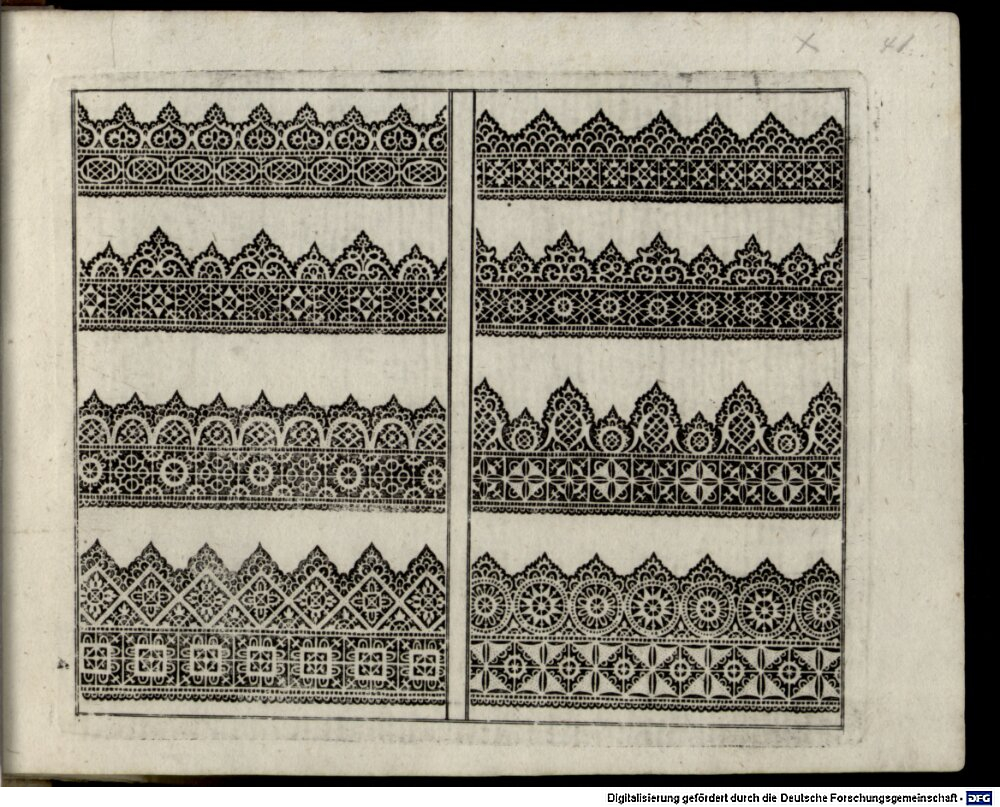
There are also pages with needle lace patterns:
Image 00083

Another one that is available on line is Federico Vinciolo's I Singolari E Nuovi Disegni. The Dover edition of this book is one of the first ones I bought when I first started doing historically based embroidery.  It is available on several sites, here is one.  This one will be familiar to many as "the purple cover."   The Vinciolo also has both charted designs and needle lace patterns.

In fact, one of the charted designs is one that I used for one of my earliest pieces done for the SCA.  I did this stag in several forms -- canvas, free and blackwork -- each of them a little bag.  I was originally going to do it in all 12 of the Athena's Thimble categories (though I haven't figured out how I was going to accomplish it in a couple of the forms).  Perhaps some day I'll come back to that plan.


Here's a picture of the canvas work stag.


One of the groups I am in on Facebook is Historic Hand Embroidery.  There, a link was given to a blog post of a list of modelbuchs, including links to ones that are on line.  I forsee an afternoon of clicking and downloading :)  Here is the Modelbuch list.

There are a couple of things to remember about these books:  They are very "late period" to people in the SCA, they freely "borrowed" from each other (you will find designs repeated across books), and unlike today's pattern books, they give no guidelines as to how the embroider was to be executed.  There are no color keys, no stitch diagrams, no materials lists.

So, as I continue to work on the pieces for my upcoming classes and for my big couching & laid project, I am also building up my "to do" list as I peruse these books.  It may be time to make some lists.


Monday, November 30, 2015

A little research

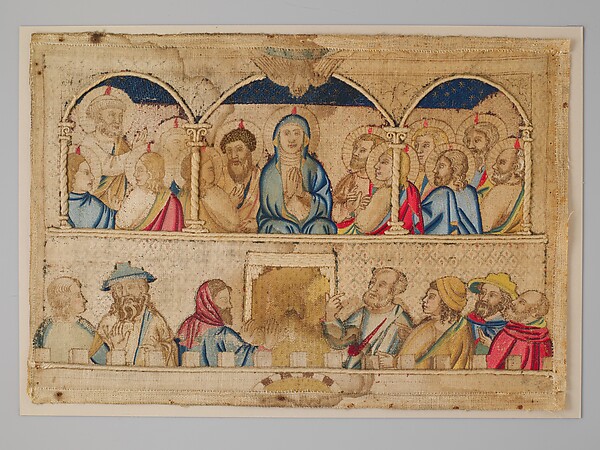
One of the pieces I want to do for my Couching and Laid work presentation is of threads or cords couched as part of an embroidery, but *not* metal thread.  There isn't a lot that is not metal thread, however, the Met does have a lovely series of 14th Century Italian pieces.  Below is an example (found here).  Others are referenced in this post, the titles are the links.
The Pentacost
If you follow that link and examine the piece carefully, those architectural arches are couched down cords.

Now, if it was just one piece, I might think that those cords are places that the metal thread has fallen  away, or been removed. However, there are a number of pieces.  Certainly metal thread that has fallen away would not fall away that completely on all of the pieces.

It does still remain possible that the metal thread was all deliberately removed, and then it would be all gone.  There are other reasons I think not, however.  Note the halos .. there is nothing there, but there are some of the couching threads still around the circle.  This is particularly easy to see in the piece titled The Ascension.  Another factor is that the cords that are present are in very good shape. If these were cores of metal threads, removing the metal would have left some damage to the cords.

Another think I love about these pieces is that they appear to be in various stages of completed.  The designs have been printed or drawn on the ground fabric.  Some, like Christ Carrying the Cross and The Baptism of Christ are missing a lot of the embroidery.  From the "crumbs" left, it looks like much of it has fallen away.  Some are more complete, such as Presentation in the Temple, where many of the colors are still bright and clear.

Overall, a wonderful set of embroideries to spur lots of thought, speculation and inspiration.

Monday, November 2, 2015

Research tool box -- Google Images

This week I started the research and design for one of the pieces I am doing as supporting items for my Expert panel.  Because it is a surprise item, I can't talk much about the specific item, so I thought I'd say a few things about research. Today I'll talk about using Google Images.

For the project in question, I was given certain parameters (the embroidered item must represent "X").  Let's say "X" is an acorn (it's not, but let's pretend... oh, I see how this is going to go, I'm going to wind up with *two* projects).

Next, I want to have the project have a look appropriate to the person's persona time and place.  Mine is 12th Century and since the acorn is part of my Household badge, we'll use 12th Century.  Next I went to Google Images and typed "12th Century acorn."  Lots of hits.  Most of them not actually on point.  Many items not actually 12th Century, many not actually showing an acorn, but a few good hits.  Many of those good hits are on Pinterest these days.  That's ok as long as you follow the links and get to actual content.  Pinterest is both a boon and a bane to researching.  I happened to find this link to a file on Wikicommons.  I'll be filing that away for future research, though it may be a bit busy for my current design thoughts.  It does purport to be 12th Century, though, and certainly depicts acorns, so it's worth remembering for more info.

For the actual project, I did find a Pinterest link to a manuscript from the correct century with an illustration of the element(s) desired, and I'm pretty happy with it.  I was having trouble getting more information -- several Pinterest boards linked to the same broken link so I wasn't finding the actual source of the item.  That's when I used Google Image search again.  Now, I use a Windows machine, and I'm afraid I don't know how to do this on anything running a different OS, but I"m sure there's a way:  I right clicked on the image and selected "Search Google for this Image."  Another way is to save the image to your computer then, in Google Images click on the camera icon to search by image and upload it,  Using this, I found a link to a digitized version of the book the image came from.  With this I had the documentation I was looking for to be able to cite the source of the image.

Searching on Google Images can be a powerful tool.  Sometimes it takes a few tries to get some useful images out of the search (try "Medieval" or "Renaissance" instead of the century, for instance), and even the good hits will take some more research to determine if the image is what you're looking for, but it's a good jumping off point.  Keep in mind that it is a *start* but far from a *finish* for good research and documentation.  Another problem, of course is the rabbit hole.  For instance in the example above -- created just for doing this post, I have found an image that just yells at me to have something done with, both embroidery and the brain space going "look at that hood."

Now, I'm off to look at some more possibly 12th century acorns... I do have a couple other supporting projects to design.

Wednesday, October 28, 2009

A website for inspiration -- The V&A

Have you explored the Victoria & Albert Museum’s website? Have you been lately? It has long been one of my favorite websites for textile inspiration. From the home page, if you click on “Collections” you have the opportunity to look at the highlights from many different departments.

However, if you click on “Search the Collections,” you go here, their newly redesigned search area. There are now over 1,000,000 items in the database, lots of them with photos – and many of those photos are high resolution. You can search by keywords, and indicate if you prefer all results, or only those with photos, or only those which are the “Best quality records including image and detailed description.” Once you get your results, they can be narrowed by several factors. If you select to view them in list view (which still includes a small photo), you can sort them by any of these headings: Place of origin, Date, Artist/maker, Location.

On a recent “test run” I did a search on the word “border” and requested only records with images. The result was “over 1,000 records.”

My options for narrowing results were:

Category: Ceramics (365), Delftware (265), Earthenware (130) Embroidery (132), Lace (147), Textiles (349)

Collection: Ceramics Collection (408); South and South East Asian Collection (142); Textiles and Fashion Collection (396)

Material: Earthenware (165); Silk thread (147);

Place: England (123); Greece (112); Turkey (143)

Style: Ottoman. (140)

Technique: Embroidery (159); Glazing (243); Lace making (127) Weaving (197)

I decided to look at “Category Embroidery.” Note that Category/Embroidery, Collection/Textiles and Fashion Collection and Technique/Embroidery each has a different number of results. Not every item has all fields completed, so it’s best to do multiple searches.

Once I got my list of 132 items, I sorted by Date – clicking it twice to have the oldest item at the top. The 8th item down was the Tristan Quilt, a piece I love to come back and look at. Here’s a link to the item: Bed cover - The Tristan quilt - Victoria & Albert Museum - Search the Collections  This link was easy to place in this blog, with the “share” button that appears at the top of the listing – it sent it right to my blog, where I saved it in draft, and edited the entry with the rest of this text.


The listings provide far more information than they used to as well. It has all the basic information (place, time, technique, etc.) and a summary, but there is also a “more information” tab. The one for the Tristan quilt provides lots of details. A third tab brings up a map with a marker – I believe it is meant to be the location of where the item was made, or possibly found.

From this page you can print, obtain a PDF of the listing (including the “more information” but not the map) and order the image(s).

To be able to order images, you will need to set up an account – it’s free. Before you place your first order, you’ll need to provide details (though the initial registration is just email address, user name and password).

Ordering multiple images is a little cumbersome. As each image goes into your cart, be careful to use the BACK button on your browser, not the “Back to search results” button on the order page – that one will take you back to the search result list, not to the item you were looking at. If there are more images (the Tristan Quilt has nine), you will need to select each one and order it.

One great improvement – you can save your order for later – and you can name it (default name is the date, in European style so my order today is 2009-10-28). Handy when you’re browsing on a break at work. When you’re ready to place your order, click on the red “Your Orders” box at the top right. Select the appropriate order and click “Place Order Now.” (If you haven’t already provided contact details, you’ll be asked for them at that point). Your order will move to “Pending Orders” and within 15 minutes (they say) will be in “fulfilled orders” and you can download high resolution photographs of the piece.

So, go browse, register and order some study photos. See what inspires you. Me? Well, there’s one panel with an archer that may just be added to my “queue.”