Showing posts with label MMA. Show all posts

Monday, January 18, 2016

Another museum piece.

Well, once again, I'm between being able to show you new work of mine.  So, today I'll show you one of the pieces that was in the recent exhibit at the Met.  This cloth totally blew me away on so many levels.  It is Accession Number 51.147, Cover Containing Animals and Floral Ornaments.   A beautiful linen piece, it is embroidered net (Lacis), cutwork and needle lace.

The lacis is incredibly fine.  I couldn't get the exact gauge, but it is easily 15 holes to the inch or more. In this shot you can also see some of the cutwork and some of the needle lace.


This happy dragon has some little friends -- any surprise I focused on the squirrels for a photo?


Some of the squares showed more wear than others, and there were a couple of places that showed probable repair, but overall the piece is beautifully preserved.

Here is a square of the needle lace, and a couple of the cutwork.  The lacis panels are larger squares, with these smaller squares making up borders.


It's a large piece, and was displayed in a manner which made it really easy to study.  It is so large, it took three photos to get the whole thing. There is a lot of material here for inspiration.


Even when I have a lengthy list of on decks projects I love taking time to look through photos, and search museum collections websites.  There is a creative energy trapped within those threads that flows and renews my energy, even for applying to completely different projects.  An hour with these images and I am usually revved up to get back to my needle and thread. 


Monday, January 4, 2016

Welcome back and happy new year

The end of year holidays are over, and A Study in Textiles is back.  It's Monday, so time for some historic embroidery talk.

Over the holidays I was able to go to the Met to see the exhibit "Fashion and Virtue" which focuses on embroidery design books, mostly from the late 16th Century (with a couple things earlier and a few things later).  The exhibit continues through January 10 -- and if you've been thinking about it, and still have the chance, I would say GO.

Fortunately, photos are permitted (of all but one item).  I will also say that the Met knows how to put on an exhibit of textiles.  Pieces are displayed in such a way as to be able to get pretty close to the items, to really *see* them.

I have a full album of my photos (and a few other things I photographed that day) on Flickr (feel free to grab my photos, but please give full credits, both to the object owners and to me).  For most items, the label follows the photo(s).

But, I really want to share a couple of things.

For instance, there is this lovely photo, showing the pricking holes used to transfer this embroidery cartoon to fabric:
That's the kind of detail in an exhibit I love to see.  Not only does it cover "oh, look, here are beautiful things" but also "here are things that are beautiful and were used and here is how they were used."

Of course, the focus of the exhibit was the embroidery books or "modelbuchs."

There were a lot of them.  Certainly more than I have ever seen in one place (eve in reprints).

One of the things that was clear is that the printers of these books "borrowed" liberally from each other.

For example, here is a page displayed as being from one book (Christian Egenolff, Modelbuch aller Art Nehens vn[d] Stickens 1`535 -- and yet, I know that some of the designs on this page appear in at least one other book.

There were a number of motifs and designs that appeared in several places throughout the exhibit.

The exhibit was vast, and the photos will provide much for me to talk about in future posts (For instance, I will want to devote a post just to the embroidered net....oh, yes).  I spent over two hours and took over 350 photos -- and there was a lot that I did not photograph.  It was a wonderfully constructed exhibit, and I only wish I had gone earlier in its run, so that I could have gone again.


Monday, December 7, 2015

Happy busy Monday

Coming up for air to do a very quick post and let my fingers rest a little from seam finishing on my husband's silk tunic for Saturday.  I had today off from work and have spent most of it in my studio working on this.  Suddenly, I'm not able to make myself "cut corners" -- so even though I originally said "I'll finish the seams after Saturday" here I sit, finishing seams.

I did spend some time over the weekend working with a friend on designs for some embroidery  -- one of which will ultimately be part of my Couching & Laid embroidery presentation.

The requested embroidery is for clothing, and there is only a little bit of specific evidence of what clothing embroidery of the period looks like, none of which is actually what we want to use.  We turned, instead, to designs in other mediums.  A search on the Metropolitan Museum of Art's "Search the Collections" helped again, and we found a design on a piece of jewelry which will translate to couched cord admirably.

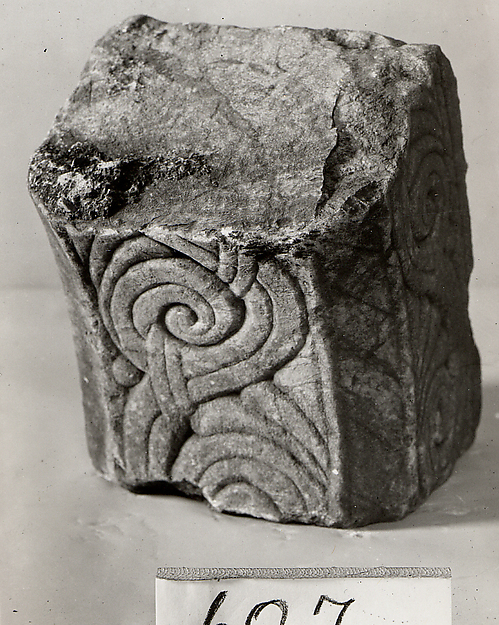
Good sources of general embroidery motifs can be found in architecture, jewelry and paintings of the period you are looking for.  Here is a lovely architectural piece that has a design I have seen echoed in embroidery of many periods, and which could be translated in many forms.  Perhaps next summer, when I am looking for new challenges I will do something with it.

Arch Fragment, ca. 1130-40, MMA Accession 25.120.607
The Cloisters Collection 1925
Well, back to seams.  Hopefully next week I'll be able to show off his new tunic and shirt.

Monday, November 30, 2015

A little research

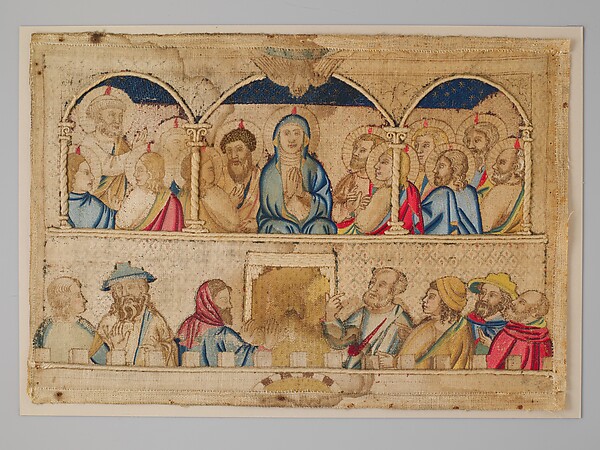
One of the pieces I want to do for my Couching and Laid work presentation is of threads or cords couched as part of an embroidery, but *not* metal thread.  There isn't a lot that is not metal thread, however, the Met does have a lovely series of 14th Century Italian pieces.  Below is an example (found here).  Others are referenced in this post, the titles are the links.
The Pentacost
If you follow that link and examine the piece carefully, those architectural arches are couched down cords.

Now, if it was just one piece, I might think that those cords are places that the metal thread has fallen  away, or been removed. However, there are a number of pieces.  Certainly metal thread that has fallen away would not fall away that completely on all of the pieces.

It does still remain possible that the metal thread was all deliberately removed, and then it would be all gone.  There are other reasons I think not, however.  Note the halos .. there is nothing there, but there are some of the couching threads still around the circle.  This is particularly easy to see in the piece titled The Ascension.  Another factor is that the cords that are present are in very good shape. If these were cores of metal threads, removing the metal would have left some damage to the cords.

Another think I love about these pieces is that they appear to be in various stages of completed.  The designs have been printed or drawn on the ground fabric.  Some, like Christ Carrying the Cross and The Baptism of Christ are missing a lot of the embroidery.  From the "crumbs" left, it looks like much of it has fallen away.  Some are more complete, such as Presentation in the Temple, where many of the colors are still bright and clear.

Overall, a wonderful set of embroideries to spur lots of thought, speculation and inspiration.

Monday, October 26, 2015

C&L - Couched Cord on Applique

One of the simplest uses of Laid and Couched work is to place a cord or decorative braid around the edges of appliqued work.  Sometimes the cord contrasts with the motifs, as in this late 15th to early 16th century fragment from Egypt and this earlier one, and sometimes the cord blends in with the ground fabric, making the applied motif stand out, as in this Spanish banner from the very end of SCA period.  Sometimes the couched cord is metal thread and in a few examples it is leather strips with gilt, such as in The Tristan hanging (Hanging) | V&A Search the Collections

This Cushion cover includes both metal couched metal thread and couched non-metal cord, as well as some couched cord used within the applied motifs, as can be seen in this close up.

One of the pieces I will be making for my Expert panel in Couching & Laid* work will be such a piece.  It doesn't need to be a large piece, it's one of the "backup" pieces which will, together, show my ability in all aspects of C&L.

I plan to do a cushion cover, though not a long one.  I will make a cushion to fit one of the chairs my husband and I typically take to SCA events which will make it more comfortable (yes, I will be sitting on it, presumably my stitches will be good enough that it will handle it).  I am considering either straight up my arms, or a design of an oak tree with one or more squirrels under it, possibly holding needles as in my arms. I'm kind of leaning towards a nice stylized oak tree with a squirrel.

Since this project is for me and not a surprise, it is one I can discuss the process of on this blog, so there will be updates as I work.

And that's it for this week's Monday post.  Have a great week everyone. Tomorrow I get to show off some of my modern knitting that has been recently completed.


*Couching & Laid work is the category title in Athena's Thimble.

Monday, August 24, 2015

Lacis -- Embroidery on Net

Recently I was doing some research browsing on the Metropolitan Museum of Art website for background for some projects.  As often happens, I came across a lot of pieces I wasn't looking for (I was lucky enough to come across pieces I *was* looking for as well).  Having recently had a conversation with someone about the Athena's Thimble category "Lacis," pieces that fall in that category caught my eye.

One of the issues I sometimes have with doing historically based embroidery is that in many of the forms there is little to nothing by way of extant pieces that are not religious.  Embroidery on net is not one of those forms.  A lot of the work is secular in nature. (Photos for this post are found in the links, which will open in new windows, they are from the Met and the V&A.)

This fellow particularly took my fancy.

Many of the pieces are like this guy, random fragments of embroidered net, leaving us wondering what they are or were used for.

There are a few complete pieces.  This chalice veil, for instance is not only complete, it is in color (scroll down and select the other photos).

This Altar frontal from the V&A  is also complete -- and while it is classed an altar frontal, it has mostly secular motifs. I'm thinking my lovely new dining room table needs a Lacis bordered table cloth.  Perhaps alternating squares of squirrels and acorns.... After some of the current projects have been addressed.

Sunday, March 30, 2014

Not always red.

It is true, of course, that many examples of void work embroidery are red (including the two I've already discussed at the Philadelphia Museum of Art, here and here).  In fact, red is such a predominant color for "Assisi" work that some manuals will specifically say that it is always red.

Not so.

The Metropolitan Museum of Art has on display a fantastic piece in blue and yellow. Yup, blue and yellow. Blue outlines and defines the figures and yellow fills the ground.  It's a lovely large piece and I visit it every time I'm up there.   It is this piece (accession number 51.61.2).  Trust me.  The photo on their website is black and white, but the piece is in blue and yellow silk on linen

Every time I visit the piece I find something different to enjoy.  The fat little putti, the lovely leaves, the stems, the fringe on the bottom and one edge.

One visit my husband found me bouncing, just a little bit -- kind of rocking up on my toes and coming back down.  I had just realized that I could identify at least three different "hands" or embroiderers' work in the piece.  It is a large piece (53 1/2 inches long),  and this suggests that it was done in a workshop.

So, if you have a chance to go to the Met, go to Gallery 503 and visit my favorite piece.

Why, yes, I have taken many pictures.  Here are a couple:
Taken at an angle next to the case, showing some of the length
The bottom left corner, showing the lovely fringe
A section of the leaf design, look at those darling animals