Showing posts with label C&L. Show all posts

Monday, July 11, 2016

Couching & Laid Work - Couched Cord

For my Couching & Laid Work back up pieces, I needed one showing simple couched cord as a decoration.  I decided to make a cover for my Kindle Paperwhite for less obtrusive use at events.

First, I obtained a cover to fit my Paperwhite, with space for the cover to be folded over.


I chose a design from La fleur de la science de pour traiture et patrons de broderie façons aralïque et ytalique par Fr. Pelegrin, de Florence, which can be found here. Published in 1530. I chose the "bones" of the design found at 22r. Four of the motifs fit the middle of my cover well.

Next up to was to obtain materials.  I found a lovely piece of brown linen, then a trip to my local needlework store yielded tapestry weight wool for the cord and silk for couching down. I selected "my colors" of blue and gold.

Construction started with cutting a piece of the linen larger than the open cover.   I hemmed the piece of linen and assembled folded in for the book cover.  I did this to ensure that the embroidery will be  centered properly on the cover.

Here the Kindle is in the cover.  I would have preferred a larger turn over, but the way the Kindle fits in the cover precluded that.  Once the cover is done I will lace it in place to keep it better anchored.


Next, I pinned the design, which I had traced, onto the cover.


Unfortunately, the brown  linen is too opaque to use the light box.  Therefore, I had to choose another transfer method.  Since I have no "pounce" on hand, I chose the stitching method.  I carefully stitched through the paper, following the lines of the design, using a simple back stitch.  I used yellow for the places I intended to couch down yellow wool, and blue for the blue -- figuring that in this way I would limit the amount of the stitched guide lines that would need to be removed later.  Then, I carefully tore away the paper.  A thinner tracing paper would have made this easier, but with careful, steady work, it all came off without distorting the stitching. 
There we are, all outlined and ready to go.  Kind of pretty that way, too, really like this design.  Yes, those are my glasses.  I often do fine work without my glasses on -- my nearsightedness means that very close work is easy for me without correction. 

Next, it was time to start laying cord.  I started with the larger section of the blue.  For that section only I pinned the "cord" in place (though as I worked I adjusted the laid cord to more carefully follow the guide lines. 

First round down.  Since the subsequent cords would need to be "woven" through for the over/under, I carefully couched on either side of the guide lines.  Now, I was sure I had taken pictures of the next phase, but apparently I did not.  I took a large tapestry needle and loosely wove the inner blue cord, then couched it down.  Next I did each of the yellow ones. 

Blue done, starting on yellow.

All done the basic couching
Having finished the basic couching, I removed the guide lines that were showing, to have a cleaner look.  At this point, the only couching is to anchor the loops and one either side of each cross. After removing the guide lines, I went through and placed additional couching. 

And, there it is, all done -- on the cover.  My plan is now to do an applique on the back -- with couched cord around the edges. Once the linen cover is done and laced into place, I may couch cord around all the edges, but that will be addressed once the back is done. 

Close up of one quadrant


Monday, May 23, 2016

Expert Panel announcment

It is official.  I will be making my Expert panel in Couching and Laid work presentation to Athena's Thimble (SCA East Kingdom embroidery guild) on September 24, 2016.  From now until then, all embroidery will be focused on that project.

The planned items will be:

  • A Simple couched cord design
  • A banner with cord couched around the applique.
  • A piece based on the Italian pieces I talked about here.
  • The Pelican medallions I did for a friends cloak, discussed here.
  • A piece based on an Icelandic altar frontal (not yet blogged)
  • A piece of underside couching.
  • And, for the "master work" the Marshall hanging, based on the Bayeux tapestry, which has been discussed on several posts.

There are a couple of other items I'm considering as small example pieces -- samplers and "learning example" items.  There will also be a presentation of information on existing pieces used as the inspirations and the form in general.  

So, it's just about exactly 4 months.  There will be plenty of progress posts during that time!

To close, I'll leave you with a shot of one of the animals from the Marshall.


Monday, February 29, 2016

Applique Research

One of the supporting projects for the expert panel is to be an example of "couched cord around applique."  I've played with a couple of ideas for this project, with none of them really "sticking."  Then, I heard about the heraldic display challenge for Mudthaw.  Heraldic banner -- that's it!

Applique is great for banners and hangings.  It is a great way to cover a large area of fabric with a design, and is (or can be) quick to do.  Because of the usual "up there" nature of the display of banners, it is also usually a less "fussy" form of embroidery.  (Applique can also be very very fussy, but that's not what I'm going to be doing).  It is also a form that spans centuries.

So, I started looking at banners with applique and couched cord.

There's this Spanish banner at the Met.
Banner, Spanish 1596. Met Accession No. 58.172 Gift of Melvin Gutman

And then there's this long Spanish one at the Boston Museum of Fine Art.


For quite a while these two pieces were vying for the place of honor as the "inspiration piece" for my project.

Tab from a banner
Ashmolean Accession No.  EA 1984.134
However, there is another group of applique that really sings to my heart -- several pieces of Egyptian work like this one at the Met and this one at the Ashmolean.
Fragment, 13th-14th century Egypt. Met Accession No. 1974-1131


Fragment Late 14th to Mid 15th Century
Met Accession No. 1972.120.2
Fragment Late 15th to Early 16th Century
Met Accession No. 1972.120.3

Those examples do not have the couched cord around the appliqued figures, but this and this one at the Met do.


My final design is a bit of an amalgam of these.  It will be a banner of linen on linen, using mostly white or off white.  To use SCA heraldry, there will also be blue and gold -- as the final banner will display the household badge my husband and I registered.

This weekend I'll be pulling out fabrics and getting the pieces cut.  I may have to actually fabricate cord from silk threads, but we'll see.  This may mean another trip to Fireside, but since I'll be heading there Saturday for the final shopping for my class the following weekend, that's not a problem.

Monday, February 15, 2016

Pelicans for Mael Eoin

Another project can be revealed!  A number of months ago I was approached by a friend to do embroidery for a Pelican cloak* for her husband. She gave me the date of the planned event, and I consulted my calendar.

Now, as those who follow this blog probably know, I am working on projects which will be the body of supporting work when I present for Expert ranking some time this summer in the East Kingdom embroidery guild Keepers of Athena's Thimble in the Couching and Laid work category.  Since as much of my work as possible needs to be towards that end, I suggested an embroidery that would apply, and my friend agreed.

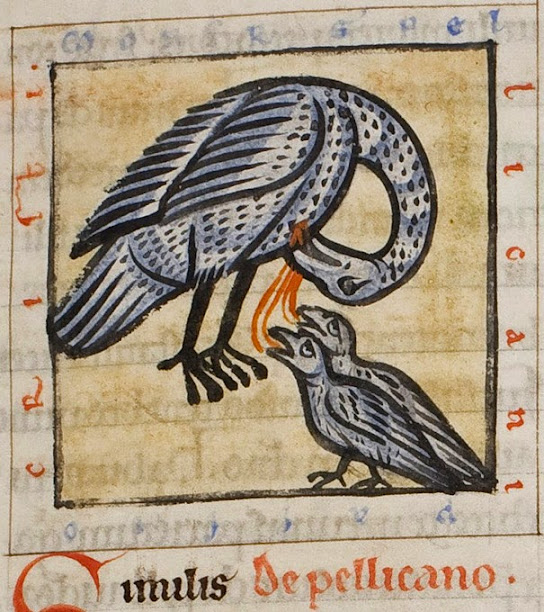
Next was research.  There are a number of pelican in piety images that are commonly used in the SCA, but I wanted something a little different.  The recipient has a 12th Century persona, so I went looking for a 12th Century depiction of the pelican.  I found a lovely website with lots of pelican pictures: http://bestiary.ca/beasts/beastgallery244.htm. Among the pictures was this one, which simply called out to me.  

It is from MS 89/54, Folio 6, Groosteminarie Library, Bruges, which contains an Aviary of Hugh of Fouilloy, dated to ca. 1190-1200. I suggested to my friend two small medallions on the shoulders of the cloak based on this illustration, reversed to face each other, done in the laid and couched technique known as convent stitch.  

No, convent stitch is not actually period to the time of the illustration -- this was an "SCA stretch." It was, however the only way I could fit doing this project in my time schedule and she was happy with the presented design and plan.  

I used some nice sturdy linen from my stash and Splendor silks to execute the design.  My "artist" was, as in many of my projects, a good clear print out of the source picture traced, then copied at ratio to fit the size desired and reversed, also on the copier.  This was in lieu of my own art skills (negligible, tracing is kind of the limit of it), and an in house artist. 


First, the outlines, ribbons of blood and feet were done in stem stitch.  I used two strands of splendor for the outlining.  I used a lighter shade for the outlines of the baby birds than for the mother bird.  Should I do such a project again, I would use the same for both, as I think there is not quite enough contrast on the baby birds from a distance.  
Anyone else thinking "vampire birds" here?  
Next, I filled the bird bodies with convent stitch, using a lighter shade in each instance. One aspect of convent stitch that was interesting to me is that it is all straight up and down.  Unlike other embroidery forms, even other laid and couched forms, there is no definition provided by using different directions.  

Next, a nice deep blue (chosen in conference with my friend) for filling in the background.  It wasn't until I was nearly done filling in the first one that it occurred to me to mark the couching lines. and now the babies have no legs.  
Neither of those bother me much, Most people will see these from a distance. This is primarily a ceremonial item, and only those who are really good friends will be close enough to see that the lines are not perfectly straight.  

I did find that silk does not really want to play at convent stitch.  Wool, which is the fiber used in many extant pieces, would "fluff up" and fill in for better coverage than the silk.  I compensated by taking extra stitches after an area was done if I felt the couching had opened up the laid stitches to allow too much of the background through. 

The final touch was dark gold chain stitch around the outline, which added a pop of color, a good sewing place for mounting, and helped to even off the edges a little bit. 


My friend brought over the cloak that had been made by someone else (and a lovely cloak it is, too), and I hung it on my dress form and positioned the medallions.  I carefully whip stitched them in place, catching only the cloak (not the lining) all the way around.  


Now that it has been presented, the recipient and I will get together at some point, with him in appropriate garb, to check the positioning and adjust if necessary. I'll try to get some good shots of him in the cloak and do a follow up post.

Another really cool aspect is that part of the elevation includes a scroll -- here is a picture of the scroll done by Natalia Anastasiia Evgenova -- she used the same illustration.  No, we didn't coordinate that! I'm going to call it "great minds thinking alike!"

Photo by Photo by Constable Calin Macsalny of Barony Bhakail
*Yes, this is an SCA thing.   For those not in the SCA, the Order of the Pelican is the society wide honor given for service.  Typically a cloak or other outer garment is given, usually with a depiction of a "pelican in her piety."

Monday, November 30, 2015

A little research

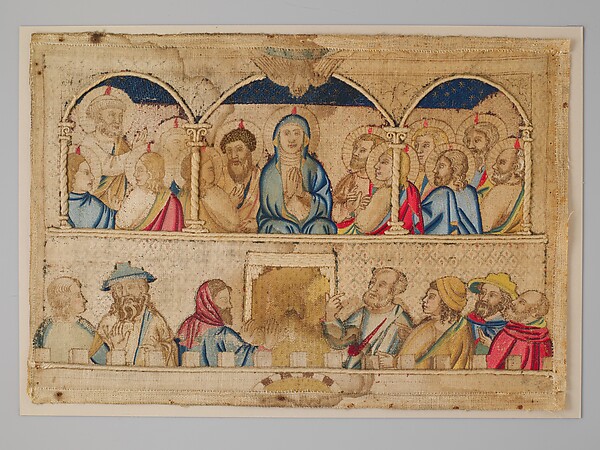
One of the pieces I want to do for my Couching and Laid work presentation is of threads or cords couched as part of an embroidery, but *not* metal thread.  There isn't a lot that is not metal thread, however, the Met does have a lovely series of 14th Century Italian pieces.  Below is an example (found here).  Others are referenced in this post, the titles are the links.
The Pentacost
If you follow that link and examine the piece carefully, those architectural arches are couched down cords.

Now, if it was just one piece, I might think that those cords are places that the metal thread has fallen  away, or been removed. However, there are a number of pieces.  Certainly metal thread that has fallen away would not fall away that completely on all of the pieces.

It does still remain possible that the metal thread was all deliberately removed, and then it would be all gone.  There are other reasons I think not, however.  Note the halos .. there is nothing there, but there are some of the couching threads still around the circle.  This is particularly easy to see in the piece titled The Ascension.  Another factor is that the cords that are present are in very good shape. If these were cores of metal threads, removing the metal would have left some damage to the cords.

Another think I love about these pieces is that they appear to be in various stages of completed.  The designs have been printed or drawn on the ground fabric.  Some, like Christ Carrying the Cross and The Baptism of Christ are missing a lot of the embroidery.  From the "crumbs" left, it looks like much of it has fallen away.  Some are more complete, such as Presentation in the Temple, where many of the colors are still bright and clear.

Overall, a wonderful set of embroideries to spur lots of thought, speculation and inspiration.

Monday, November 2, 2015

Research tool box -- Google Images

This week I started the research and design for one of the pieces I am doing as supporting items for my Expert panel.  Because it is a surprise item, I can't talk much about the specific item, so I thought I'd say a few things about research. Today I'll talk about using Google Images.

For the project in question, I was given certain parameters (the embroidered item must represent "X").  Let's say "X" is an acorn (it's not, but let's pretend... oh, I see how this is going to go, I'm going to wind up with *two* projects).

Next, I want to have the project have a look appropriate to the person's persona time and place.  Mine is 12th Century and since the acorn is part of my Household badge, we'll use 12th Century.  Next I went to Google Images and typed "12th Century acorn."  Lots of hits.  Most of them not actually on point.  Many items not actually 12th Century, many not actually showing an acorn, but a few good hits.  Many of those good hits are on Pinterest these days.  That's ok as long as you follow the links and get to actual content.  Pinterest is both a boon and a bane to researching.  I happened to find this link to a file on Wikicommons.  I'll be filing that away for future research, though it may be a bit busy for my current design thoughts.  It does purport to be 12th Century, though, and certainly depicts acorns, so it's worth remembering for more info.

For the actual project, I did find a Pinterest link to a manuscript from the correct century with an illustration of the element(s) desired, and I'm pretty happy with it.  I was having trouble getting more information -- several Pinterest boards linked to the same broken link so I wasn't finding the actual source of the item.  That's when I used Google Image search again.  Now, I use a Windows machine, and I'm afraid I don't know how to do this on anything running a different OS, but I"m sure there's a way:  I right clicked on the image and selected "Search Google for this Image."  Another way is to save the image to your computer then, in Google Images click on the camera icon to search by image and upload it,  Using this, I found a link to a digitized version of the book the image came from.  With this I had the documentation I was looking for to be able to cite the source of the image.

Searching on Google Images can be a powerful tool.  Sometimes it takes a few tries to get some useful images out of the search (try "Medieval" or "Renaissance" instead of the century, for instance), and even the good hits will take some more research to determine if the image is what you're looking for, but it's a good jumping off point.  Keep in mind that it is a *start* but far from a *finish* for good research and documentation.  Another problem, of course is the rabbit hole.  For instance in the example above -- created just for doing this post, I have found an image that just yells at me to have something done with, both embroidery and the brain space going "look at that hood."

Now, I'm off to look at some more possibly 12th century acorns... I do have a couple other supporting projects to design.

Monday, October 26, 2015

C&L - Couched Cord on Applique

One of the simplest uses of Laid and Couched work is to place a cord or decorative braid around the edges of appliqued work.  Sometimes the cord contrasts with the motifs, as in this late 15th to early 16th century fragment from Egypt and this earlier one, and sometimes the cord blends in with the ground fabric, making the applied motif stand out, as in this Spanish banner from the very end of SCA period.  Sometimes the couched cord is metal thread and in a few examples it is leather strips with gilt, such as in The Tristan hanging (Hanging) | V&A Search the Collections

This Cushion cover includes both metal couched metal thread and couched non-metal cord, as well as some couched cord used within the applied motifs, as can be seen in this close up.

One of the pieces I will be making for my Expert panel in Couching & Laid* work will be such a piece.  It doesn't need to be a large piece, it's one of the "backup" pieces which will, together, show my ability in all aspects of C&L.

I plan to do a cushion cover, though not a long one.  I will make a cushion to fit one of the chairs my husband and I typically take to SCA events which will make it more comfortable (yes, I will be sitting on it, presumably my stitches will be good enough that it will handle it).  I am considering either straight up my arms, or a design of an oak tree with one or more squirrels under it, possibly holding needles as in my arms. I'm kind of leaning towards a nice stylized oak tree with a squirrel.

Since this project is for me and not a surprise, it is one I can discuss the process of on this blog, so there will be updates as I work.

And that's it for this week's Monday post.  Have a great week everyone. Tomorrow I get to show off some of my modern knitting that has been recently completed.


*Couching & Laid work is the category title in Athena's Thimble.

Monday, September 14, 2015

Icelandic Laid and Couched work

As part of my approach to an Expert panel in Laid and Couched work, I am looking into the Icelandic style, known as refilsaumur.  It is a surface couching very similar to Bayeux work, with the difference that the background is also worked.

The article, Traditional Icelandic Embroidery by Elsa E. Gudjonsson is my primary source for information on this work.  It appeared in Reykajavic Icelandic Review in 1982 and is available on line at Scribd.  The article was expanded into a book  which, while it has a listing on Amazon, is out of stock and rarely available -- I'll be seeking to borrow a copy through Inter Library Loan.

Photo from Amazon.com

My plan is to do a motif based on those seen on this altar frontal. While this was a religious piece, I will probably use a secular theme. 
Photo from http://medieval.webcon.net.au/loc_scandinavia_iceland.html
A clearer look at the work would help, there will be some research done soon.  

Sorry for the short post today -- I've been head down into some projects which will be the subject of October posts, after the projects have been seen.